Recycling and Sustainability at Chiswick Skip Hire
 At Chiswick Skip Hire we place sustainability at the heart of everything we do. Our approach to creating an eco-friendly waste disposal area and a genuinely sustainable rubbish area combines practical skip hire services across Chiswick with measurable environmental targets. We operate a modern fleet and work with borough initiatives to make sure bulky waste, construction rubble and household clearances are processed in the lowest-carbon way possible.
We believe in transparency: our standard operating practice records material flows from collection to final recovery, and we publish an annual recycling percentage target to demonstrate progress. That target is a driving metric for our teams and transport partners, and it influences how we sort, separate and divert waste away from landfill. Our commitment covers everything from paper and cardboard to garden waste and metals.
 The London boroughs covering Chiswick, notably the London Borough of Hounslow, have clear guidance on waste separation that we mirror in our local operations. Residents and businesses are encouraged to separate food waste, dry recyclables (glass, plastics, paper) and garden waste at source. As a responsible provider of skip hire in Chiswick we reinforce those borough-level systems by offering labelled bins, on-site segregation and tips for maximising recovery during each hire.
Our Recycling Percentage Target and How We Achieve It
We set a formal recycling percentage target of 85% recovery by 2028 for materials collected via our Chiswick waste services — a target that includes reuse, recycling and energy recovery where appropriate. That means prioritising reuse and donation before recycling, and recycling before energy recovery. This ambitious target is supported by data-driven route planning and selective transfer station partnerships.
To hit this goal we focus on both front-end and back-end measures: front-end separation at the point of hire, and back-end processing agreements with resource recovery facilities. Our teams are trained to spot materials suitable for reuse — such as timber, doors, windows and kitchen fittings — and to divert these items to charitable partners and salvage yards where they can be repurposed.
 Practical steps include:
- Segregating glass, metals, plastics and paper on-site
- Collecting textile and clothing for local re-use schemes
- Separating inert materials (brick, concrete) for crushing and reuse in construction aggregates
Local Transfer Stations and Low-Carbon Logistics
We work with several local transfer stations and materials recovery facilities (MRFs) across West London to ensure the proper sorting and processing of mixed loads. By selecting nearby transfer hubs we reduce vehicle miles, accelerate turnaround times and cut emissions. Our partnerships are chosen for the facility’s capability to handle complex waste streams — from mixed construction and demolition waste to segregated household recyclables.
To reduce transport emissions we operate a fleet of low-carbon vans and Euro-6 compliant trucks. Where possible we deploy hybrid vehicles and test electric vans for lighter deliveries and small clearances. These low-emission vehicles form part of our overall carbon reduction plan, which is monitored alongside our recycling figures and diversion rates from landfill.
We also use efficient route planning software to reduce empty running and ensure our Chiswick rubbish removal services are as low-impact as possible. The combination of transfer station selection and low-carbon logistics helps create an efficient eco-friendly waste disposal area for the local community.
Partnerships with charities and social enterprises are central to our sustainability model. We have formal relationships with local charities that accept usable furniture, appliances and textiles, ensuring items recovered during clearances have a second life. These collaborations support vulnerable communities, reduce waste, and lower the need for new production — a core tenet of circular economy practice that benefits Chiswick and neighbouring boroughs.
By directing reusable items to charities we also lower the tonnage that must be processed by MRFs, improving our recycling percentage and enabling us to reallocate landfill-avoidance resources where they have the greatest impact. Items commonly diverted include working white goods, mattresses (when accepted), and household fittings — all of which often find new homes through trusted partners.
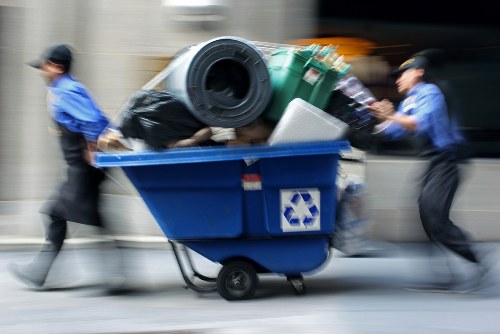 We maintain clear separation streams for common recyclable categories relevant to local residents: glass bottles and jars, mixed paper and cardboard, food waste for anaerobic digestion, garden waste composting, and textiles. For construction projects we add separate bins for inert aggregates, metals, timber and hazardous materials so that each stream can be processed appropriately and with maximum recovery.
Waste education is part of our service: every Chiswick skip hire booking includes guidance on what can be recycled and how best to sort materials on-site. That guidance reflects local council rules and the practicalities of kerbside and communal collection schemes across the boroughs. Clear labelling and staff advice help households and businesses contribute to the circular economy.
We also audit larger clearances and commercial projects to recommend the most sustainable waste management plan. This can include specifying segregated containers, arranging pre-collection sorting sessions, and scheduling direct transfers to specialist recyclers for specific streams such as plasterboard, metals and asphalt — all steps that raise the percentage of materials diverted from landfill.
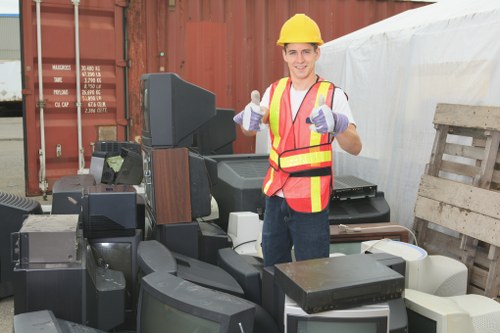 In summary, our Chiswick skip hire and Chiswick waste services are designed to create resilient, low-impact waste systems: ambitious recycling percentage targets, partnerships with local transfer stations and charities, and the use of low-carbon vans and smarter logistics. By aligning with borough-level waste separation policies and investing in reuse-first principles, we create a practical, community-focused model for an eco-friendly waste disposal area and a truly sustainable rubbish area for Chiswick and the surrounding London boroughs.